
Auburn, WA Siding Contractor
Expert Siding Installation in Auburn, Washington
- Expert Siding Installation & Repair
- Energy-Saving Siding Solutions
- James Hardie Certified Contractor
Our Simple Siding Installation
Process

Schedule a
Consultation
Get answers to your siding challenges with an on-site consultation. We’ll inspect your exterior and provide an accurate, customized quote.

Design Your
Home Exterior
From material selection to color consultation and timeline planning, we keep open, clear communication so we can meet all your expectations and budget.

Enjoy Your
Home Again
Truly relax in your home again, knowing your home exterior was installed properly and will protect your home for decades to come.
Expert Siding Installation in Auburn, Washington
Auburn straddles a geographic divide that affects everything about siding performance: the flat, fertile Green River valley floor gives way to the rising terrain of Lea Hill and West Hill, creating dramatically different conditions for homes only a mile apart. Valley-floor homes in downtown Auburn and along the Auburn-Kent corridor sit in a zone of higher humidity, morning fog, and cooler air pooling that keeps siding surfaces damp well into each day. Hillside homes on Lea Hill and Lakeland Hills enjoy better air circulation and faster drying but trade that advantage for increased wind exposure and the rain that comes with slightly higher elevation. Lifetime Exteriors evaluates each Auburn home’s specific position and orientation to ensure the siding system we install is matched to the conditions it will actually face.
Auburn’s housing stock reflects waves of development tied to the area’s economic anchors. Older homes near downtown and along the White River were built in the 1940s through 1960s when the valley was still largely agricultural. The Lea Hill area saw heavy development in the 1980s and 1990s as families moved east from the Kent valley. Lakeland Hills, one of Auburn’s newer large-scale developments, brought 2000s-era subdivision homes with a different set of siding characteristics. Lifetime Exteriors works across all of these eras and understands the construction practices, materials, and failure patterns typical of each generation of Auburn homes.
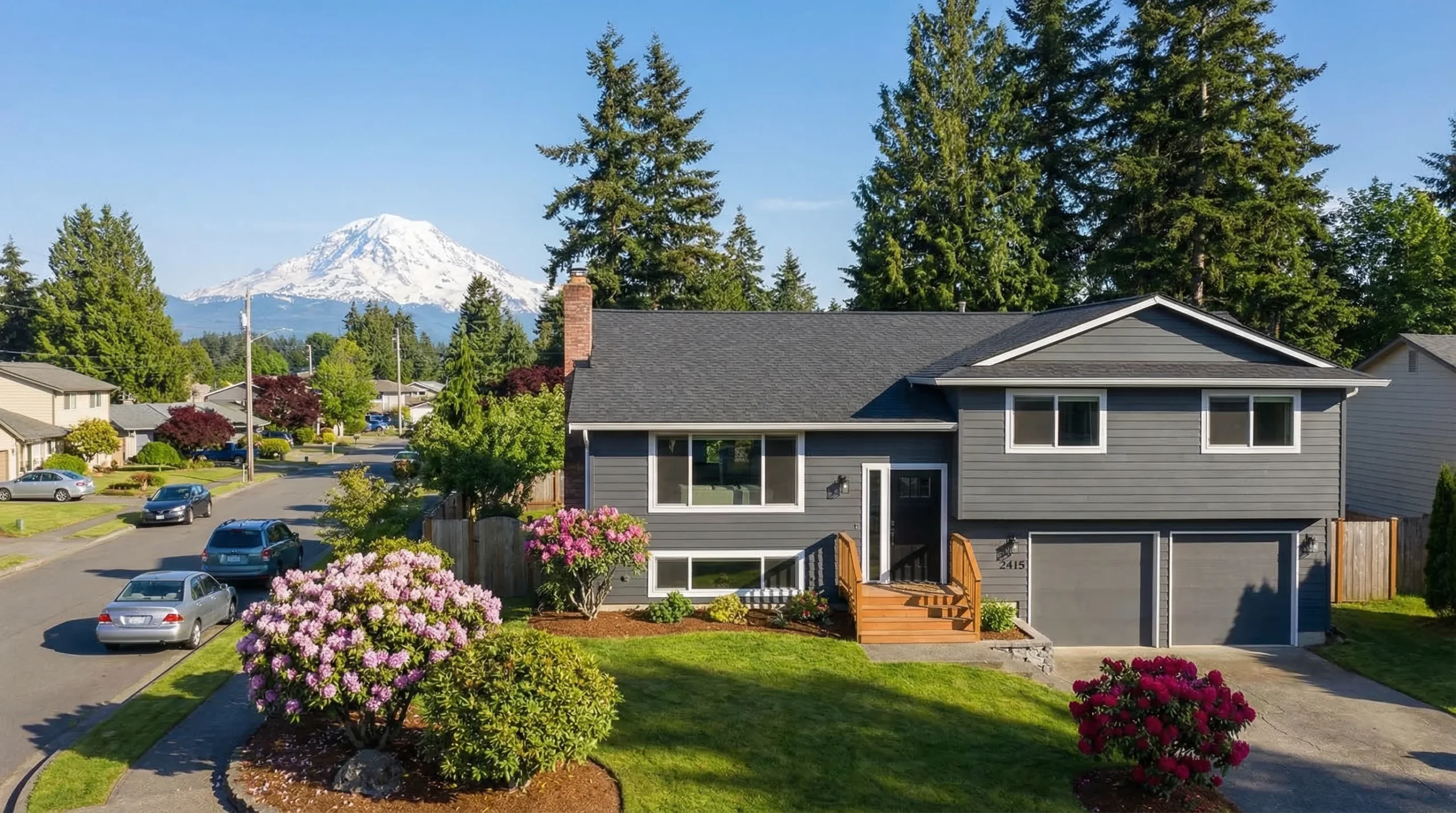
Siding Services for Auburn Homes
Siding Installation
Auburn siding installations vary significantly based on where the home sits in the valley-to-hillside topography. On valley-floor homes near downtown and along A Street, we frequently encounter older construction with minimal weatherproofing and siding materials that have absorbed moisture for decades. These projects require comprehensive wall-system upgrades including new sheathing in damaged areas, a modern weather barrier, and careful attention to ground-level details where the high water table and proximity to the Green River create persistent moisture conditions. On Lea Hill and Lakeland Hills, installations are more often upgrades from builder-grade vinyl to fiber cement on homes from the 1990s and 2000s, with less structural repair but still requiring proper moisture management for the hillside conditions.
Siding Repair
Auburn homeowners call us for repairs that range from replacing a few rotted boards on a valley-floor cottage to re-securing wind-damaged panels on a Lea Hill hillside home. One pattern we see frequently in Auburn is moisture damage concentrated at the junction between a home’s concrete foundation and the siding, particularly on the valley floor where ground moisture levels are high and the original builder did not install adequate clearance or flashing at the siding-to-foundation transition. We address these ground-level failures with proper Z-flashing, adequate clearance, and sometimes the addition of a waterproof membrane along the lower wall section.
Siding Materials
James Hardie fiber cement siding handles Auburn’s valley humidity and hillside wind exposure equally well, which is why it is our primary recommendation regardless of where the home sits in the city’s topography. For the Lakeland Hills area and newer Lea Hill subdivisions, the ColorPlus factory finish is popular because it offers a maintained appearance without the painting cycle. For older Auburn homes near downtown, where budgets may be more constrained, LP SmartSide engineered wood provides a significant improvement over existing T1-11 or hardboard at a moderate price point. We avoid recommending untreated cedar for Auburn valley-floor homes because the high ambient humidity accelerates cedar deterioration faster than in hillside locations.
Repair or update your
Single-Family Home, Townhome, Condo, Multi-family Home, Or Commercial Property
Serving Auburn Neighborhoods
Auburn’s neighborhoods divide naturally between valley and hill. Lea Hill, the city’s largest residential area, climbs the ridge east of the valley with homes built primarily in the 1980s and 1990s. The area’s combination of moderate elevation, some wind exposure, and tree cover creates siding conditions where moisture and limited drying are the primary concerns. West Hill, on the opposite side of the valley, offers a similar elevation and era of construction. Lakeland Hills, Auburn’s master-planned community in the southeast, features newer construction from the 2000s with consistent architectural styles and HOA oversight. Downtown Auburn and the surrounding valley-floor neighborhoods have the city’s oldest housing, dating from the 1940s through 1970s, with siding that has endured decades of valley humidity and ground moisture. Mountain View and Terrace View provide additional hillside residential areas where our crews work regularly.
Neighborhoods We Serve:
Lea Hill West Hill Lakeland Hills Downtown Auburn Mountain View Terrace View
Auburn Weather & Your Siding
Auburn’s valley floor sits at one of the lower elevations in the south King County area, and this topography shapes its microclimate. The city receives approximately 38 inches of rain annually, but cold air pooling in the valley creates frequent winter fog and frost events that keep surfaces damp and produce freeze-thaw stress on aging siding materials. Morning fog in the Green River valley is thick enough to coat siding with visible moisture on most winter mornings, even without rain. Lea Hill and West Hill, rising 400 to 500 feet above the valley, experience less fog but more direct precipitation and occasional wind events. The sharp contrast between valley and hillside conditions within a single city makes Auburn a place where generic siding recommendations fall short, and site-specific evaluation is essential.
Complete Exterior Services in Auburn
Beyond siding, Lifetime Exteriors provides complete exterior services in Auburn, WA.
Also Serving:
Kent, WA • Federal Way, WA • Renton, WA • Tacoma, WA
FAQ
Significantly. Valley-floor homes in Auburn sit in a humidity zone created by the Green River corridor, where morning fog, cool air pooling, and elevated ground moisture keep siding surfaces damp for extended periods. Wood siding products deteriorate notably faster on the valley floor than on Lea Hill or West Hill. Fiber cement siding, which absorbs no moisture, is the best choice for Auburn’s valley-floor homes.
Yes. Lakeland Hills has architectural guidelines for exterior modifications, and we regularly prepare HOA submission materials for homeowners in this community. We bring product samples and color swatches to the homeowner’s review and are happy to attend HOA meetings if needed to answer questions about the proposed siding materials.
The most common issue on Lea Hill is builder-grade vinyl siding from the 1990s that is fading, becoming brittle, and starting to allow moisture behind the panels at failed joints and window flashings. These homes often look okay from a distance but have hidden moisture issues at the wall-to-window transitions. An upgrade to properly flashed fiber cement eliminates both the cosmetic and moisture problems.
If your Auburn home is on the valley floor, freeze-thaw cycles are a genuine concern for aging siding. Valley-floor temperatures drop below freezing more frequently than on the surrounding hills, and moisture that has penetrated into wood or hardboard siding expands as it freezes, accelerating deterioration. Fiber cement is dimensionally stable through freeze-thaw and is not affected by this cycle.
LP SmartSide engineered wood offers the best balance of performance and affordability for Auburn homeowners. It costs less than James Hardie fiber cement but provides significantly better moisture resistance than vinyl, T1-11, or natural cedar. For the best long-term investment, especially on valley-floor homes with high moisture exposure, fiber cement remains the superior choice despite its higher upfront cost.
Ready to transform your home’s exterior?
Contact Lifetime Exteriors today for a free siding consultation and estimate.
